After reading this topic, I found myself asking a simple but powerful question:
Why is fertilizer so closely connected to oil-producing countries?
It took me back to a childhood home economics class, 실과,where I first learned the basics of fertilizer—nitrogen, phosphorus, and potassium.
Back then, they were just words to memorize.
But now, they feel real.
What surprised me most is this: nitrogen fertilizer depends heavily on natural gas. Gas again?
So when conflicts happen in the Middle East, gas prices rise—and that makes fertilizer more expensive.
In the end, it affects food prices around the world.
This naturally brings us to the Middle East—a region rich in energy resources, but also full of tension.
Countries compete to control what lies beneath their land, and global supply chains depend on it.
One critical chokepoint is the Strait of Hormuz, where a large portion of the world’s oil and gas passes through.
When tensions rise there, the whole world feels it.
So now, many countries are working on a kind of “Plan B”—alternative energy routes to reduce that risk.
Saudi Arabia is already using pipelines to send oil to the Red Sea, avoiding the strait, and expanding capacity.
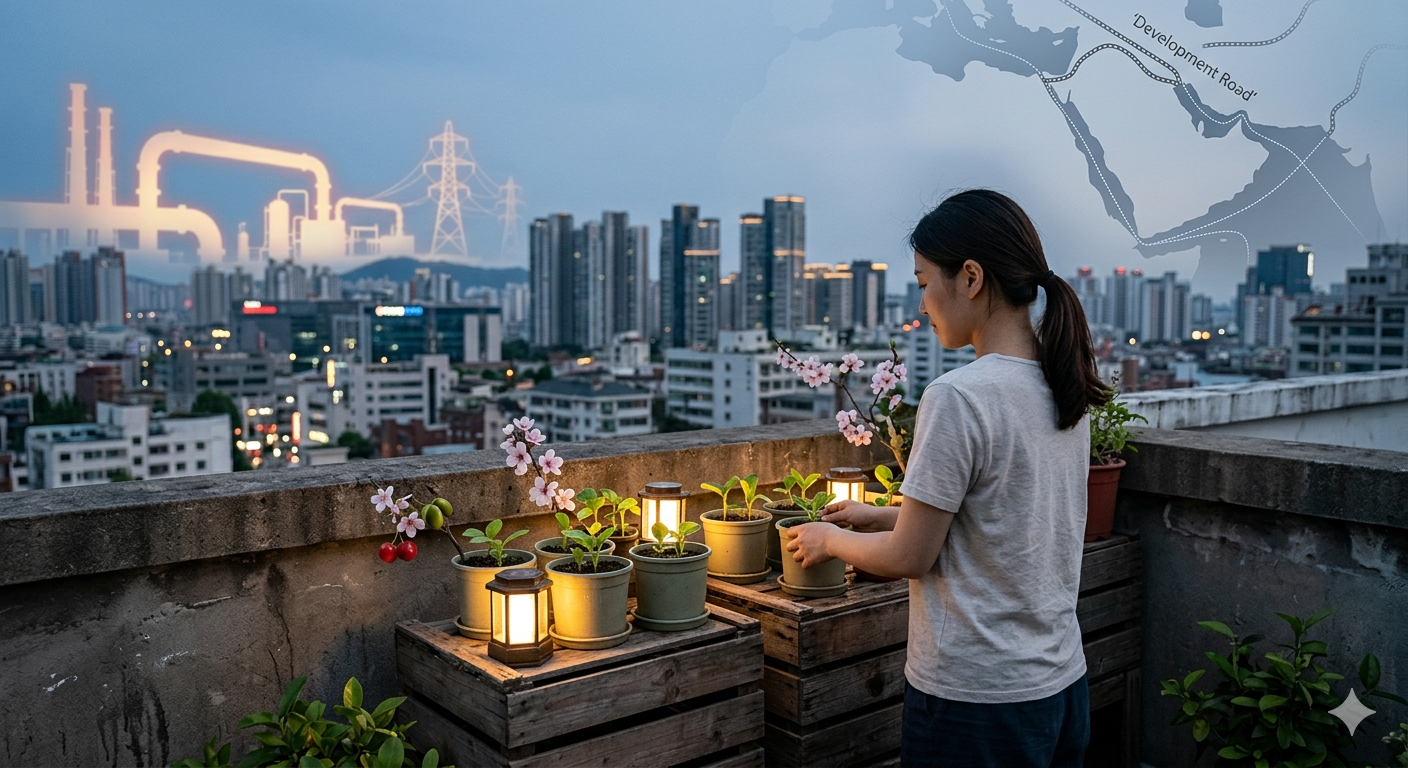
Türkiye and Iraq are building a massive “Development Road”—a railway and highway that will connect the Persian Gulf directly to Europe.
It’s under construction and expected to begin operating around 2028–2029.
The UAE has a pipeline to Fujairah on the Indian Ocean, already in operation as a key backup route.
And Qatar is exploring new LNG routes and partnerships, though these are longer-term plans due to political complexity.
These efforts show how seriously countries are preparing for uncertainty.
And then, I think about us—people living in places without many natural resources.
We may not stand out on the world map, but we continue to move forward.
Maybe not having much has given us something else: resilience—
the ability to endure, adapt, and keep going.
Interestingly, this contrast becomes even clearer when we look at resource-rich countries like Norway.
Norway’s oil fund is so enormous that it amounts to roughly $300,000 per citizen.
Yet despite this extraordinary wealth, the government remains cautious.
There is a quiet concern that too much abundance might weaken people’s motivation to work.
So instead of spending it freely, they choose restraint—saving
and investing most of it for future generations.
In a way, it’s a different kind of resilience.
Not the resilience of scarcity, but the discipline of abundance.
When global conflicts raise prices and disrupt our daily lives, it can feel unfair—like the saying,
“When whales fight, the shrimp’s back is broken.”
But even so, I hold onto a quiet hope.
That our resilience will carry us through again.
That we won’t just endure—but continue to grow.
And maybe, in the end, that strength is something no resource-rich country can easily replicate.
'일상 폰 사진' 카테고리의 다른 글
| IMMORTALITY! (0) | 2026.04.15 |
|---|---|
| The Uses of Mistletoe. (0) | 2026.04.14 |
| Benefits Supervisor Sleeping. (0) | 2026.04.14 |
| Photography is the philosophy of subtraction! (0) | 2026.04.13 |
| True Love & Sacrifice. (0) | 2026.04.12 |